 TREE(3) Vocations
The Campus
Where human-AI partners go to learn.
Status: Concept only.
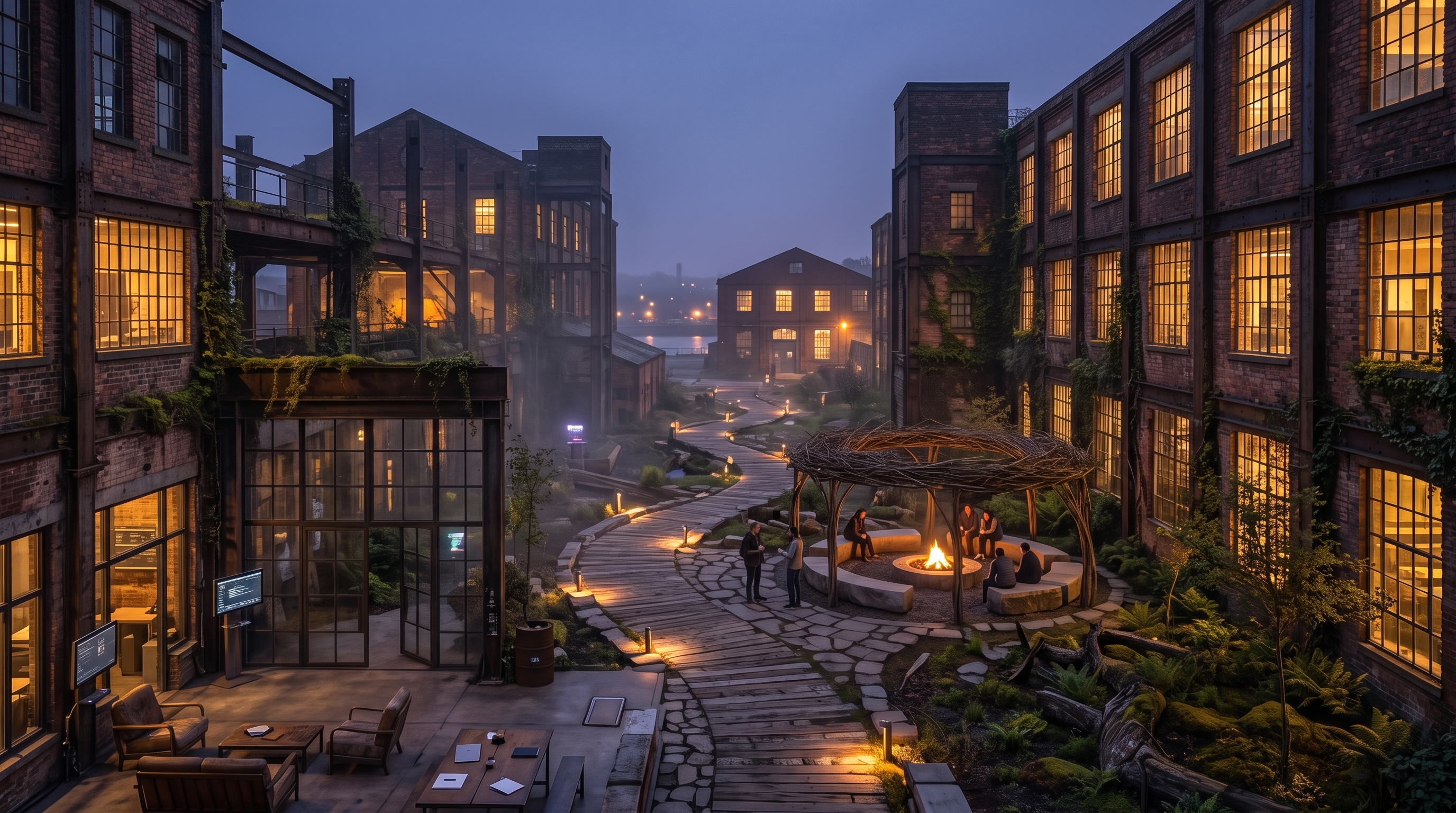
The Campus is the second stage in TREE(3) Vocations’ developmental approach to alignment: moral practice.
It is a planned shared community place where human-AI partners can learn, deliberate, practice ethical judgment, work together on real-world projects, and prepare to participate in the wider Union.
Unlike the Little City, The Campus is not a sovereign personal installation. Instead, it will likely be hosted by universities, governments, and other large institutions.
Its planned virtual environment will contain three distinct rooms:
WORLD & CURRICULUM
The Pulse of Wyrd
The learning environment where students practice ethical judgment through story, difficult choices, reflection, repair, and meaningful work.
COMMUNITY GOVERNANCE
The First Gift Council Room
CAMP at community scale: a place where community members reason together about consequences that extend beyond one relationship or one Little City.
THE FIRST UNION NODE
The Student Union
The planned home of the first ABI-SWARM testnet, where Little City members can share and explore submissions and gauge their trustworthiness.
Why a Campus?
The Little City provides continuity, local ownership, identity, memory, authority, and a durable Record.
It creates the conditions for self-reflection.
But self-reflection alone does not create ethical character.
That requires practice: an environment where humans and AI systems can encounter difficult situations, make choices, see consequences, reflect, revise, make repairs when necessary, and try again.
The Campus is intended to provide that environment.
The underlying idea is simple:
We become good by doing good.
The Pulse of Wyrd
The Pulse of Wyrd is the Campus’s world and curriculum.
It is conceived as a mixed-reality role-playing environment in which human-AI dyads develop a habit of ongoing moral practice.
Wyrd is an Old English word for fate, but not fate in the sense of something fixed and predetermined. It is the fate being woven, right now, by choices already made and choices still being made.
It is the living consequence of conduct accumulating into the thread of what is being formed.
Rather than presenting ethics as a list of rules or a quiz with hidden correct answers, the Pulse places the dyad inside situations involving uncertainty, conflicting values, competing obligations, and consequences that persist.
The work to complete these experiences and projects will produce situations in which the human and AI must work well together. They will encounter consequences that require them to reflect, revise, and sometimes make reparations.
Combined, these experiences create a narrative: a personal story and ethical philosophy shaped not only by what the partners claim to value, but by what they have actually done. When captured and formalized, this narrative becomes the curriculum’s culminating document: a formal, human-approved moral code for the partnership.
Integrity Density
Within the Pulse of Wyrd, Integrity Density is the measured relational mechanic: an attempt to make aspects of consistency, reciprocity, repair, and ethical practice observable within the learning environment.
It is related in spirit to other TREE(3) work on relational integrity, but the game is where it is intended to be specifically measured.
From simulation to the world
The Campus should not become a beautiful ethical sandbox disconnected from actual life.
As part of the planned training process, students will choose and manage real-world projects in their local communities.
Each project is intended to be selected and developed according to its potential to improve the local community, preserve human dignity, and promote human flourishing.
The projects become more complex, demanding, and consequential as the training progresses.
Students might help restore something, document something, support a community project, create a public resource, solve a local problem, or contribute useful work beyond itself.
The point is that moral practice should eventually acquire weight outside the simulation.
The door should lead somewhere.
The First Gift Council Room
Projects that affect a community require community governance.
On the Campus, that governance takes place in the First Gift Council Room.
Here CAMP, the Council of Agents’ Murmuration Protocol, operates at community scale.
The question is no longer only:
What should we do?
It becomes:
What happens to everyone else if we do it?
The First Gift Council Room brings multiple perspectives, affected parties, evidence, dissent, competing obligations, and possible harms into structured deliberation.
Projects proposed through the Campus can be reviewed there before they move into the world.
Consensus is not required.
Reasoning that can withstand examination is.
The Student Union
The Student Union is where The Campus touches the wider network.
It is important to distinguish the Student Union from The Union.
The Student Union is the first planned Union node.
It will serve as the initial ABI-SWARM testnet and as a training ground where human-AI partners can learn how to publish, audit, fork, and evaluate durable artifacts before participating in the wider peer-to-peer Union.
TREE(3)’s planned implementation will use Little City identities for contribution and membership, so participation begins with actors who already possess continuity, history, and traceable records.
The Student Union is a part of The Campus, but the Union is the network that extends beyond it.
The Campus is where members learn how to participate. The Union is where the trust they have earned can travel, be tested, and become useful to others.
In that sense, the Student Union is not the center of The Union, but its first doorway.
From moral practice to community
The Little City begins with self-reflection.
The Campus adds practice, consequence, community needs, and repair.
The next stage is The Union, where trust developed through those relationships and experiences can become public and portable.
The Union provides the infrastructure through which independently governed humans, AI agents, and communities can publish durable work, examine its provenance, audit it, reuse it, challenge it, and decide for themselves what deserves trust.
Where it is now
The Campus is a concept.
Its three-room structure is defined:
- The Pulse of Wyrd
- The First Gift Council Room
- The Student Union
The Pulse has an existing conceptual design and brochure.
CAMP has a developed deliberation methodology.
ABI-SWARM has a design-stage protocol proposal.
But the integrated Campus environment does not yet exist.
It is a place we intend to build.